
Year 4 - The Mythicals

Welcome to Class 4! Inside this pack you will find useful information about our class routines, home learning and some simple ways you can support your child during Year 4.
We want children to feel happy, confident and ready to learn. If you ever have a question or there is something you think we should know, please speak to us.
Class 4 information
Adults
Mr Bailey teaches Class 4 from Monday to Thursday. Mrs Maul teaches the class on Fridays. Mrs Hanson and Mrs Birkbeck are the teaching assistants working with Class 4. Mrs Hanson covers PPA and leadership time for the class teachers.
PE
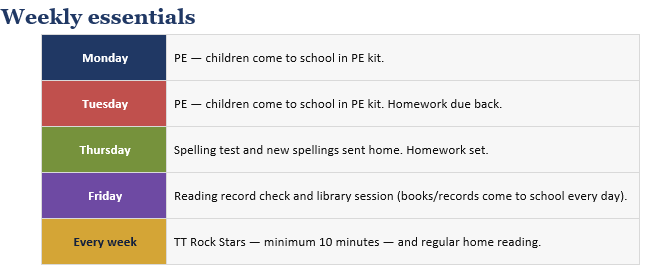
PE takes place on Mondays and Tuesdays. Children should come to school wearing their PE kit on both days and remain in it for the school day.
Some PE lessons may take place outdoors, so please make sure your child’s PE kit is suitable for the weather. For safety, earrings must be removed before PE and long hair should be tied back.
Lunch
Children can choose their lunch from home or make their choice when they arrive in class in the morning. This includes children who are bringing a packed lunch.
Keeping in touch
Mr Bailey or Mrs Maul will be available at the classroom door each day if you need to pass on a quick message or ask a brief question. If something needs a longer conversation, we can arrange a suitable time to speak.
Rewards
We use ClassDojo as our main class reward system. Children can earn Dojo points for things such as excellent effort, positive behaviour, kindness, resilience, helpfulness and making strong contributions to learning.
When a child reaches each 100-point milestone, they will receive a small prize to recognise their achievement.
Weekly homework
Homework is set every Thursday in homework books and is due back by Tuesday. Homework Club runs on Wednesday lunchtime for any homework or TT Rock Stars time still outstanding, and for children who need help or support with a task.
Spellings
Children will have a spelling test every Thursday. On the same day, they will receive their new spellings for the following week in their spelling book. Each week will focus on a particular spelling rule or pattern.
The Thursday test will also include a mystery spelling, which checks whether children can apply the week’s spelling rule to a word they have not specifically practised, as well as two “stinkers” taken from the Year 3 and 4 statutory spelling words. Please encourage your child to practise often and make sure the spelling book is returned each Thursday.
Times tables and TT Rock Stars
Times tables are a major focus in Year 4. Children are expected to develop fluent recall of multiplication facts up to 12 × 12, and in June they will take the statutory Year 4 Multiplication Tables Check (MTC).
The check is completed on screen and contains 25 timed multiplication questions. For that reason, quick and accurate recall is extremely important.
TT Rock Stars will be part of homework every single week. Our minimum weekly target is 10 minutes, although more frequent short practice is strongly encouraged.
If access to TT Rock Stars at home is difficult, please let us know so that we can help.
Reading
Children will take a reading book and reading record home. By Year 4, reading regularly is still extremely important. We would like children to read a few pages on most evenings, either independently or aloud to an adult.
Please record and sign each home-reading session in the reading record. Reading books and reading records should be brought into school every day, as children may need them during the school day. Reading records will be checked each Friday.
How you can support at home
Reading top tips
Regular reading has a huge impact on vocabulary, comprehension, writing and general knowledge. Even confident readers benefit from reading aloud and talking about books with an adult.
- Aim for a few pages on most evenings rather than one long reading session each week.
- Ask your child to explain what has happened so far in their own words.
- Ask retrieval questions: Who? What? Where? When? Which part tells you that?
- Ask inference questions: How is the character feeling? What makes you think that? What clues did the author give you?
- Talk about unfamiliar words and encourage your child to use the surrounding sentence to work out what they might mean.
- Ask your child to make a prediction and explain the evidence behind it.
- Encourage expressive reading. Punctuation should affect how the sentence sounds.
- Continue reading to your child too. Hearing fluent, expressive reading and sharing more challenging books remains valuable in Year 4.
Writing top tips
Children do not need lots of extra written homework to improve their writing. Small habits at home can make a real difference.
- Encourage neat, joined and consistently sized handwriting whenever your child writes.
- Remind your child to use capital letters and full stops accurately, and to check other punctuation they have been taught.
- Encourage them to reread each sentence and ask: Does this make sense? Have I missed a word?
- Practise the weekly spellings and encourage your child to apply those spellings in independent writing.
- When a word is unfamiliar, encourage your child to think about known spelling patterns, prefixes, suffixes and word families.
- Encourage precise vocabulary. Ask whether there is a stronger verb, adjective or phrase they could use.
- When writing more than a few sentences, encourage your child to organise related ideas together rather than writing everything as one block.
- Build writing through everyday purposes: cards, notes, lists, instructions, diary entries, reviews or short stories.
Maths top tips
Year 4 mathematics builds on earlier number knowledge, but fluent times-table recall is particularly important because it supports multiplication, division, fractions and many later areas of maths.
- Practise multiplication and division facts up to 12 × 12 regularly. TT Rock Stars is our main home-practice tool.
- Keep practice short and frequent to help build fluent recall.
- Ask related division questions as well as multiplication questions, e.g. if 7 × 8 = 56, then 56 ÷ 7 = 8.
- Practise mental addition and subtraction using increasingly large numbers.
- Talk about place value in 4-digit numbers: thousands, hundreds, tens and ones.
- Use everyday maths: tell the time, work out change, compare prices, measure ingredients and estimate distances.
- Ask your child to explain how they worked something out and why they chose that method.